

EU Pay Transparency Directive:
compliance requirement or lever for cultural change?
 23 February 2026
 4 min.
The European Pay Transparency Directive is not just a new regulatory obligation, it is a powerful catalyst for organizational transformation, set to impact HR processes, company culture, internal trust, and employer brand positioning.
Starting from 7 June 2026, European companies will be required to make the criteria for determining pay more transparent, communicate salary ranges during recruitment, provide access to data on average pay for equivalent roles, and report on the gender pay gap, with increasing obligations depending on workforce size.
But the real issue is not the law, it is change.
A challenge for change management
EU Directive 2023/970 was introduced to address a still relevant issue, the gender pay gap, which in Europe stands at around 13%. More structured organizations will be required to monitor and report the gender pay gap and, in the presence of significant discrepancies above 5%, analyze the causes and implement corrective actions.
However, the impact of the directive goes far beyond reporting obligations. For many companies that still operate with pay systems developed incrementally over time, often based on implicit criteria, historical exceptions, and logics never fully formalized, this regulation represents a major opportunity for evolution. It will no longer be enough to “be fair”, organizations will need to demonstrate it through data, clear criteria, and consistent decisions over time.
From a change management perspective, this means addressing at least four key transformations, affecting governance, organizational culture, and decision making processes.
From control to transparency
The management of pay information will shift from defensive confidentiality to structured transparency, requiring governance, clear communication, and managerial readiness
From intuition to systematic approaches
Companies will need to clarify job architecture, levels, pay bands, and progression criteria, reducing arbitrariness and ad hoc treatments.
From reputational risk to strategic opportunity
Pay transparency can become a lever for employer branding, attraction, and retention, strengthening trust and the perception of fairness.
From closing the gap to preventing inequalities
The real value will lie not only in correcting pay gaps, but in redesigning decision making processes, hiring, promotions, and salary reviews, to prevent inequalities from re emerging.
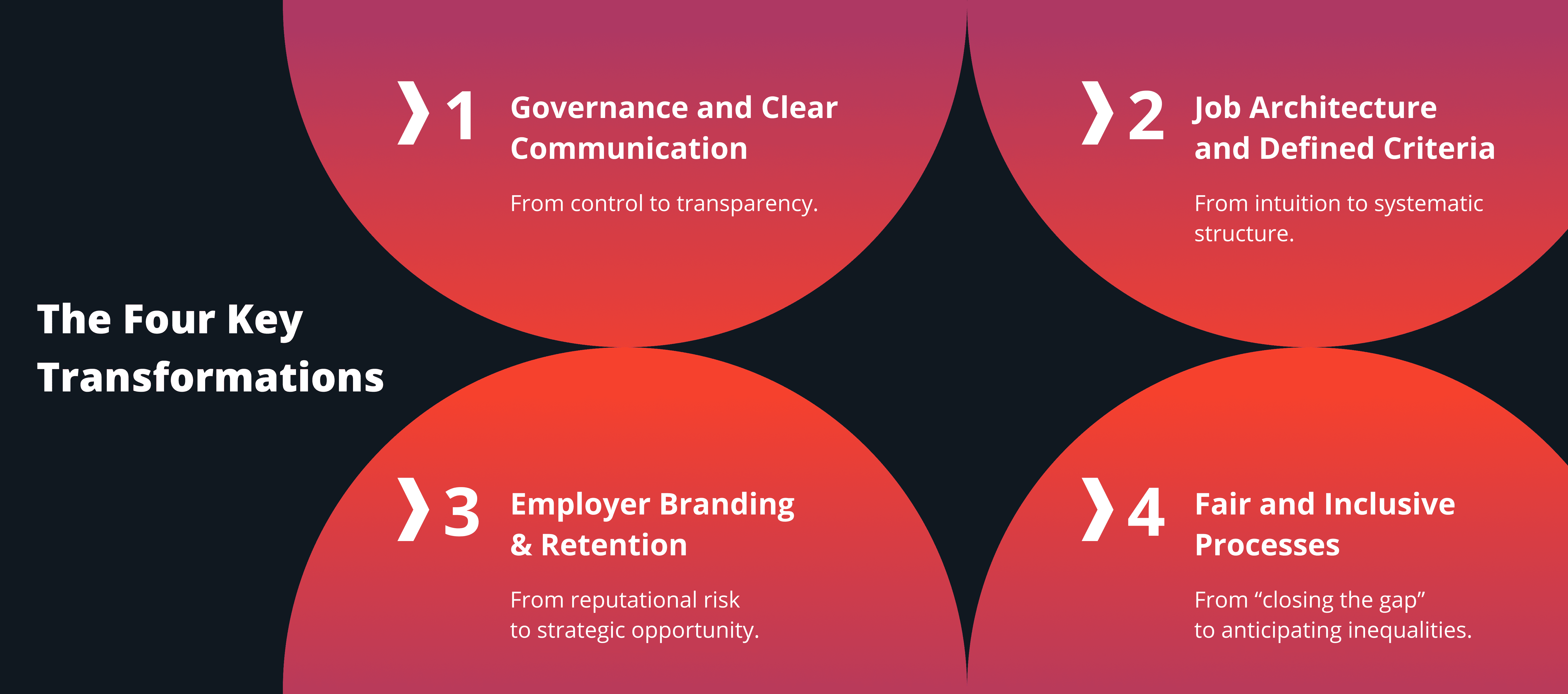
Source: OpenKnowledge
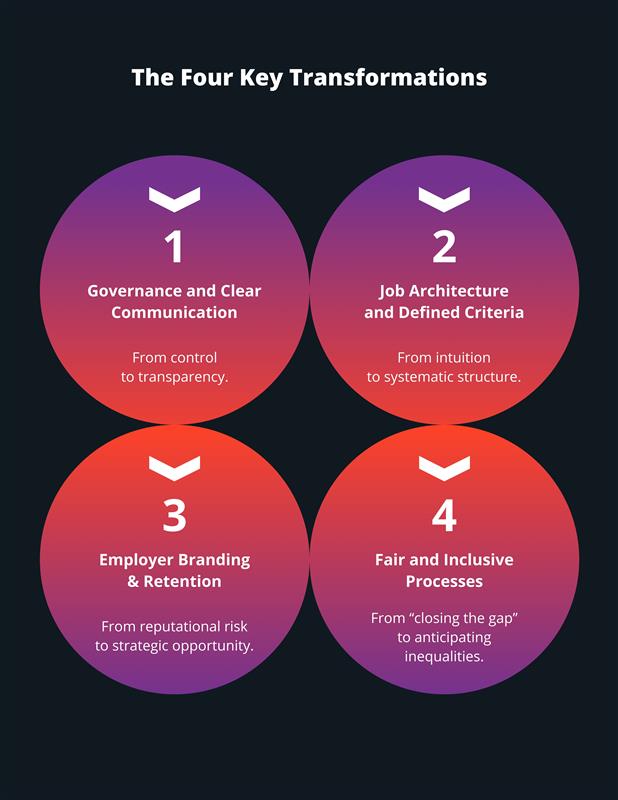
Source: OpenKnowledge
The impact on company culture
In organizations where pay systems are not always fully formalized or transparent, the introduction of the directive may raise doubts, concerns, and internal resistance. Fear of conflicts among colleagues, concern about losing negotiation flexibility, managers’ uncertainty in justifying pay differences, defensive reactions such as “we are only doing this because we are required to”.
Here is where change management comes into play. Companies that treat the directive as mere compliance risk friction and mistrust, while those that interpret it as a cultural journey can strengthen fairness, credibility, and engagement, supporting people, leadership, and mindset.
How? This directive represents a rare opportunity for HR professionals to take a leading role in facilitating conversations, building clear and defensible criteria, supporting internal management, and using data and numbers to communicate externally their commitment to fairness and attention to people.
In other words, moving from policy administrators to promoters of organizational trust.
From regulation to experimentation, our event with IDEM
This perspective was also at the core of our recent event organized in collaboration with our partner IDEM – Mind The Gap, during which we involved 25 HR professionals from Italian and international companies.
We chose a non traditional approach, a board game designed to simulate strategic decisions related to the directive, foster deeper understanding, and generate new awareness.

Source: Play the Pay Transparency Directive @ Liberty Tower, Milan
Through the game, participants were able to:
- step into the shoes of different corporate stakeholders
- discuss priorities and trade offs
- experience realistic scenarios of regulatory pressure
- learn complex concepts in a practical, concrete, and memorable way
Experiences like this show how essential it is to create spaces for dialogue, awareness, and active involvement. A topic we also explore in our article on communication and engagement as key levers for change and gender equality.
Where to start
If the directive represents an opportunity for transformation, it is worth asking, is our organization ready to move from compliance to culture? Do we have the data, the processes, and above all the language to make this change understandable and shared?
The answers to these questions can make the difference between imposed compliance and chosen evolution. And perhaps this is exactly where the future of work lies, in the ability to turn an obligation into an opportunity for collective growth.
Sources
- Mosca, M. P. (2025, 1 dicembre). Direttiva Ue sulla trasparenza salariale: come stanno procedendo i Paesi membri? Alley Oop – Il Sole 24 Ore
- IPSOA. (s.d.). Trasparenza ed equità retributiva: come la Direttiva UE cambierà il lavoro
- European Union. (2023). Directive (EU) 2023/970 on equal pay for equal work or work of equal value between men and women: rules on pay transparency
Author
Giuseppe Giordano