

From Adoption to Autonomy: Our Approach to AI Transformation
In the Agentic Era, competitive advantage does not come from technology: it comes from people who can give it direction, meaning, and value
 16 June 2026
 9 min.
Over the past few years, we have accompanied several organizations on their AI adoption journey, often starting from a recurring situation: technology available, active licenses, but still limited use and an ROI that is hard to demonstrate.
The starting point is almost always the same: companies have invested in the tools, but wonder how to turn that investment into real, widespread value. How do you move from isolated experiments to daily behaviors? How do you activate people, beyond the mere availability of technology?
What we have learned, and what market data confirms, is that technology is not the real obstacle: it is the way it is introduced, understood, and integrated into daily behaviors that makes the difference. The cultural and human factor, therefore, must be at the center.
This conviction did not begin with Artificial Intelligence. At OpenKnowledge, we have always adopted an approach that places people at the heart of transformation processes, starting from the premise that change does not happen when a technology is introduced, but when it is understood, accepted, and integrated into everyday behaviors. AI today represents a new frontier of this evolution, but the principle remains unchanged: value does not derive from the tools themselves, but from people’s ability to make them their own and use them consciously, effectively, and in line with the organization’s objectives.
AI is a human-driven tool and that is its strength
Within this journey, BIP Red has developed a specific approach to AI adoption: AI Organizational Decluttering. Drawing on OpenKnowledge’s established expertise in change management and people engagement, this methodology helps organizations gain clarity during a phase characterized by rapid technological acceleration and growing complexity.
AI Organizational Decluttering aims to remove the elements that hinder genuine AI adoption: unrealistic expectations, isolated initiatives, overlapping tools, and technology-driven approaches, to refocus attention on what generates value: clear objectives, empowered people, and redesigned processes. Because the challenge is not to adopt more technology, but to build the conditions for technology to be used effectively, consciously, and sustainably.
AI Organizational Decluttering puts back at the center what truly matters: people, processes, and decisions. It means restoring clarity on objectives, identifying high-impact use cases, developing relevant skills, and building a conscious relationship between human beings and intelligent technologies.
From this perspective emerges the concept of the AI-empowered organization: a context in which the “New Human” does not merely supervise algorithms, but defines their direction, governance, and decision-making criteria. Judgment, ethics, critical thinking, relational sensitivity, and the ability to read context become the elements that guide AI’s action and determine its real business value.
Having a human in the AI process is a good starting point. Having humans drive the AI process is where real value is created.
The concept of “human in the loop”: the person as supervisor, as the final check before output reaches the world, played a fundamental role in building trust in AI, especially during the early stages of adoption. It helped organizations experiment cautiously, avoid delegating too quickly, and maintain control. It is a necessary foundation, and in many contexts it remains so.
But it is precisely that, a foundation, not a destination. The next evolutionary step is toward a more ambitious vision: AI as a tool to be directed with intention, not merely supervised. In this perspective, it is the human who brings context, values, and vision. It is the human who asks the right questions, decides which problems are worth solving, and interprets results in light of what data alone cannot see. AI amplifies this capacity, it does not replace it.
The shift is therefore not a break, but a maturation. And it has practical consequences for how adoption journeys are designed, how people are trained, and how the success of an AI transformation is measured. The further organizations advance along this path, the more value shifts from the correctness of the output to the quality of the intention that generated it.
This is a theme that emerges forcefully in the international debate as well. In a recent discussion on AI and inclusion, Professor Payal Arora of Utrecht University, founder of the Inclusive AI Lab, highlighted something we rarely hear addressed with such clarity: designing AI “for everyone” often means creating value for no one. It is specific context, lived experience, and diversity of perspectives that determine where and how AI generates real impact. A system trained on homogeneous data, designed for an average user who does not exist, produces mediocre output for everyone.
The corollary is extraordinarily positive: human diversity, of roles, experiences, cognitive styles, cultural backgrounds, is not an obstacle to AI transformation. It is one of its most valuable resources. Organizations that manage to leverage this variety in their interaction with AI achieve qualitatively superior results: richer questions, more contextualized prompts, more nuanced interpretations.
What fascinates us about AI, and what we try to convey to the organizations we work with, is that we are not facing a tool that levels people downward. We are facing a tool that, used with intention, surfaces the best in each person: analytical capacity, critical judgment, creativity, emotional intelligence, intellectual curiosity. All competencies that the Microsoft Work Trend Index 2025 identifies as the most important to develop in the coming years, and not coincidentally, they are all deeply human.
The mindset shift, therefore, matters as much as the technical architecture. It is not about learning to use a tool: it is about redefining how we think, decide, and operate, with AI as a multiplier of human potential, not its substitute.
AI at work: more widespread than it seems, less effective than it could be
According to the Microsoft Work Trend Index 2026, 78% of workers report having used AI solutions at least once in their work. Yet, despite this widespread diffusion, the vast majority of organizations struggle to transform sporadic use into consolidated habit, and habit into real competitive advantage.
The resistances we encounter most often in the field are always the same: fear of being replaced, low familiarity with the tools, lack of trust in AI results, and, perhaps the most underestimated, inertia. Moving from a new practice to a routine takes time, accompaniment, and an organizational environment that actively supports change.
A click is not enough, and neither is a software license.
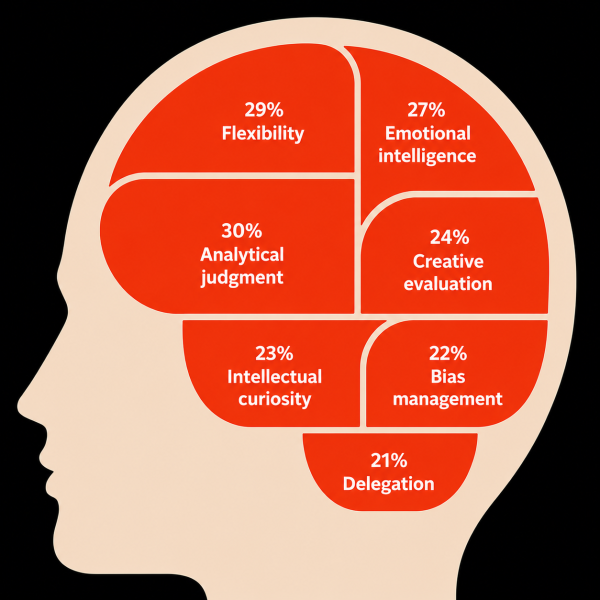
Which skills will be most important to develop? Microsoft analyzed data from a survey of 31,000 employees across 31 countries, labor market trends from LinkedIn, and trillions of productivity signals derived from Microsoft 365 usage data.
Source: Microsoft Work Trend Index *
Our approach: from AI-Ready Workforce to the Agentic Era
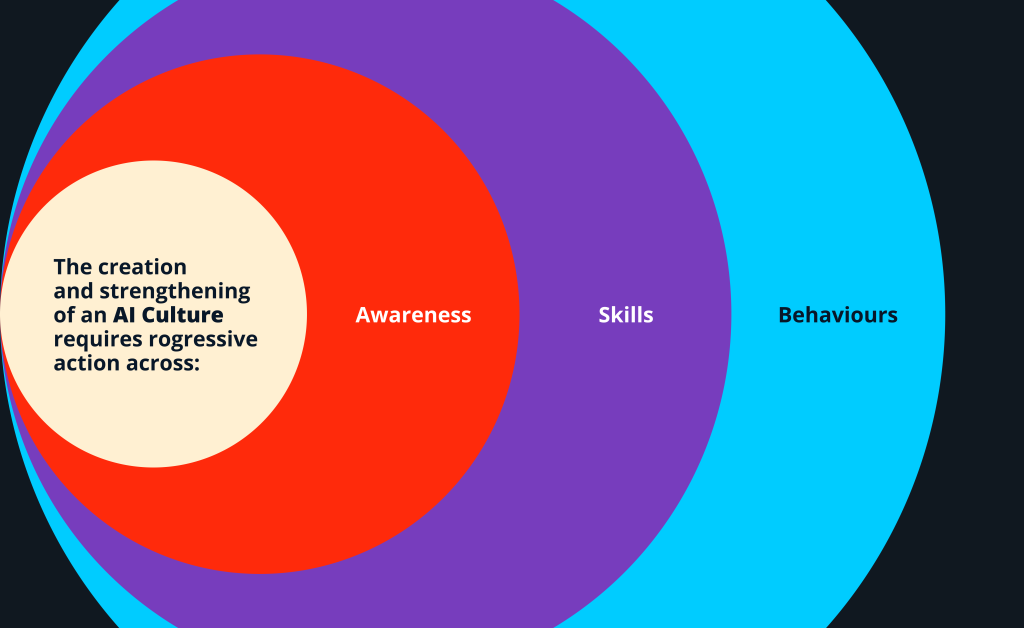
Our AI-Ready Workforce Evolution offering was born from precisely this awareness. AI transformation is not a technology project: it is a cultural journey that progressively acts on three strategic levers, Awareness, Skills, and Behaviors.
Three levers that are not sequential but interconnected. You can train people on the tools, but if there is no awareness of why it is worth using them, the training will evaporate within weeks. You can build awareness, but if daily behaviors do not change, if meetings are still prepared the same way as before, if documents are still written the same way, if no one shares the practices that work, the investment stays on paper.
The model we have developed guides people through four maturity phases:
- Discover: overcoming initial uncertainty, fear of making mistakes, resistance to the new
- Experiment: moving from exploration to practice, with concrete support on first use
- Exercise: consolidating new habits, countering the natural inertia toward the status quo
- Consolidate: taking full ownership of the transformation, becoming ambassadors of change
The journey is structured around four operational macro-phases. It begins with a preliminary Frame, analysis of specific resistances, competency gap mapping, definition of the AI change roadmap, followed by Awareness initiatives (events, lightning talks, innovation labs, communication campaigns), Skills development (bootcamps, advisory sessions, ambassador programs, learning materials), and finally consolidation of Behaviors through communities, pulse surveys, nudging initiatives, and continuous monitoring.
Every journey starts from a starting point defined with leadership and the project sponsor: target audience, solutions, use cases, and KPIs. There are no standard journeys: there are organizations with specific needs, different histories, different cultures. And we build the response to measure because a global manufacturing organization has different needs from a financial services firm, and a population of 300 people has different dynamics from one of 30,000.
But building an AI-ready workforce is only the starting point. While many companies are still consolidating basic adoption, the market is moving toward a completely new paradigm: Agentic AI.
It is a qualitative leap, not just a quantitative one. Until now we have talked about AI as an assistance tool: it helps you write, summarize, search, generate. Useful, but essentially reactive: it responds when you speak to it. Agentic AI does something different: it acts. It takes an objective, breaks it down into steps, interacts with systems and applications, verifies results, adapts. It does not wait for you to ask a question: it carries a process forward. And it is precisely here that the human-driven paradigm stops being an abstract principle and becomes an operational imperative: the more autonomous the agents, the more crucial it is that people define their objectives, boundaries, and values.
AI agents do not simply assist they orchestrate complex workflows, interact with enterprise systems, and make decisions proactively. The leading platforms, from the Microsoft ecosystem with Copilot Studio and Azure AI, to solutions built on other technology stacks, are making this scenario accessible to every business function. The organizations that know how to leverage it will set the new standards of productivity and competitiveness. And they will do so not because they have the most advanced technology, but because they have the most prepared people to lead it.
Our approach to agentic transformation is structured in four phases, regardless of the platform being used:
Initiation – Vision, priorities, and readiness
We define the foundations: AI and agentic vision, use case backlog with value prioritization, assessment of technology choices, data and security assessment, roadmap and KPIs, executive sponsorship. The starting point is not technology, but clarity on objectives.
Activation – Technical enablement and deployment
We configure the technical environment to adopt the chosen solutions and build the first agentic scenarios: tool deployment, access and data management, security controls and Responsible AI, integration with existing systems. A phase that is often underestimated, but decisive for the quality of the adoption that will follow.
Adoption – People transformation and guided learning
We activate people with role-specific skilling journeys, ambassadorship programs, communication strategies, prompt libraries and best practices, communities of practice, and continuous adoption monitoring. Because an agentic platform used poorly is worse than no platform at all.
Evolution – Agent scaling and industrialization of value
We extend the transformation toward advanced use cases: development of custom agents, multi-agent orchestration, lifecycle governance, ROI tracking, process redesign, and the construction of an AI Center of Excellence. This is the phase in which adoption stops being a project and becomes a way of working.
Fonte: OpenKnowledge
Theory is just the beginning
These are not theoretical approaches. They are frameworks refined in the field, across very different sectors and contexts, from manufacturing to financial services, from global organizations to more compact ones. And every project has taught us something that no abstract model could have given us.
What emerges most frequently, regardless of sector or size, is that the critical variables are almost always the same: the quality of executive sponsorship, the ability to translate vision into concrete behaviors, and the coherence between what is communicated and what is lived every day in the organization. When these three things align, adoption accelerates. When even one of them is missing, even the best platforms remain underutilized.
One concrete example is that of an international client we supported in their AI-driven evolution across ten workstreams at the Zone Europe level: from defining the governance of the Champions Network within the Everyday Digital program, to supporting leadership in program sponsorship, through to change management for NIVA, the AI chatbot for IT and HR. A project that confirmed for us how decisive the coherence between global narrative and local implementation is for adoption, and how crucial the ambassador role is, not only for cascading, but for keeping the sense of change alive over time.
What working in the field has taught us is that there is no universal path. There is a method, and then there is the moment when that method adapts to the specific reality of whoever you are facing: their resistances, their culture, their priorities, the tools they already use or are evaluating.
Decide. Create. Connect. To inspire in an era where technological speed risks overwhelming reflection, this is perhaps the most important thing one can do: helping organizations remain human, even as they become more intelligent.
The Agentic Era is already here. The question is not whether to transform, but with what intention to do so.
Authress
Benedetta Beneventano, Senior Copywriter in BIP Red and Lucia Coltri, Adoption & Change Director in BIP Red
* The percentages indicate the share of respondents who selected each skill as important to develop. Since the survey allowed multiple responses, the categories are not mutually exclusive and the percentages add up to more than 100%. The skills reported are those most frequently cited by participants.